 Penny Payday
How a percent off each payout works
It is one step: payout × percent = what you set aside. The rest is yours to plan with. You do it every time money comes in, so the tax money never gets mixed up with rent money.
Say a week of delivery payouts and tips adds up to $870. Here is what each percent does to it.
| Percent | Set aside | Yours to plan |
|---|---|---|
| 15% | $130.50 | $739.50 |
| 20% | $174.00 | $696.00 |
| 25% | $217.50 | $652.50 |
| 30% | $261.00 | $609.00 |
Each row adds back to $870 (for example, $217.50 + $652.50). Every 5 points of percent moves about $43.50 a week on a $870 week.
Want to try your own numbers? The gig tax set-aside calculator does this in your browser.
Does your pay have tax taken out?
- Gig and 1099 pay (delivery, rideshare, freelance): nobody takes tax out of a payout. The set-aside is how you cover it yourself.
- Tips on a paycheck job: your employer may already be withholding from your paycheck. Your pay stub shows how much. Cash tips are different: the IRS says tips of $20 or more in a month must be reported to your employer, and tips under $20 still count as income on your return (IRS Topic 761, checked November 2026).
What the percent is paying for
When you work for yourself, you owe two kinds of tax on what you earn after business costs:
- Self-employment tax. The IRS says the rate is 15.3%: 12.4% for Social Security and 2.9% for Medicare. You pay it and file Schedule SE once your net earnings from self-employment are $400 or more (IRS self-employment tax page, checked November 2026).
- Income tax on top of that, and in many states, state income tax.
Costs like miles driven for work can lower what those taxes are figured on, so the right percent is personal. Gig tax guides often use 25% to 30% as a rule of thumb. That is not an IRS number.
One way to pick a starting percent
Look at last year's return. Divide the total tax on it by what you earned from your side work or gig work. That gives you the share that went to tax.
Say last year's return showed $14,400 of net gig earnings and $2,880 of tax on them. $2,880 ÷ $14,400 = 0.20, or 20%. If your income went up this year, you might start a little higher than 20%.
This is a starting point, not a tax calculation. Your income, deductions, filing status and state all change the answer. A tax preparer can tell you your real number.
Set it aside, then plan on the rest
Keep the tax money where you can't spend it by accident: a separate account or a separate envelope. Then plan your week on the rest. Penny does this with a Taxes envelope. You pick 15%, 20%, 25%, 30% or your own, and that part comes off every payout before bills and envelopes are planned. Your daily number is figured on what's left.
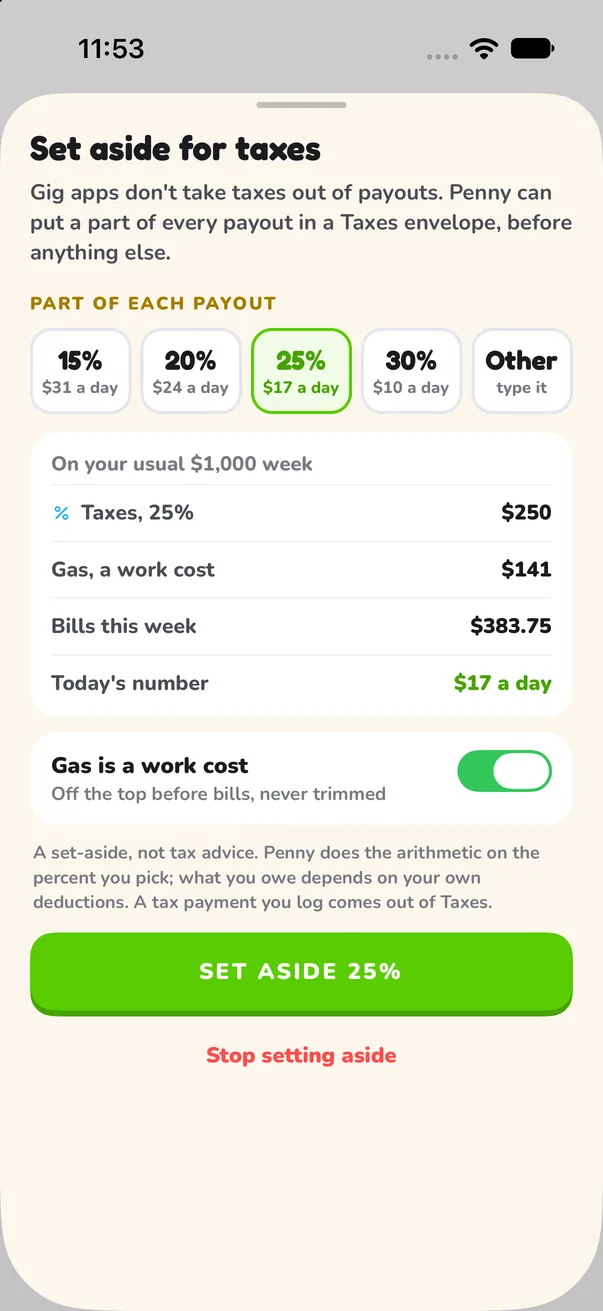
The IRS generally expects estimated payments during the year when you expect to owe $1,000 or more (IRS estimated taxes page, checked November 2026). Comparing apps for pay that changes? See budgeting apps for hourly, tipped and gig workers.
Questions
What percent of tips should I set aside for taxes?
It depends on your income, costs and state. The table above shows what 15%, 20%, 25% and 30% leave you with. Many people start at a rule of thumb and adjust once they see last year's tax. A tax preparer can give you a real number.
Do I set aside from tips and from the base pay?
If a payout includes tips, the percent is taken off the whole payout. Tips count as income on your return (IRS Topic 761, checked November 2026).
Is 25% too much or too little?
It can be either. 25% is a common rule of thumb in gig tax guides, not an IRS figure. Business costs can lower what you owe, and a higher income or a high-tax state can raise it.
Does a percent off each payout count as paying my taxes?
No. A set-aside is money you keep ready. You still have to pay the IRS yourself, on its schedule, and your state if it has an income tax. Penny doesn't file or pay taxes.

The tax part comes off first. Type your payouts and Penny sets the percent aside, then plans the rest.

This guide does arithmetic on example numbers. It is not tax advice, and Penny Payday does not file or pay taxes for you.