 Penny Payday
1. Start with what actually lands
Use the take-home number on your pay stub or bank deposit, not your hourly rate times your hours. Taxes, insurance and retirement come out before you ever see it.
If your hours change from check to check, plan on a check you can count on, like your lowest regular one, and treat anything above it as extra when it shows up.
2. Give each bill to the check before it's due
A monthly budget pretends all your money arrives on the 1st. Biweekly pay arrives in two pieces, so each bill needs a check that lands before its due date.
Jordan takes home $1,480 every other Friday. This month the checks land on the 6th and the 20th.
| Bill | Due | Amount | Paid from |
|---|---|---|---|
| Phone | 12th | $70 | Check on the 6th |
| Streaming | 15th | $16 | Check on the 6th |
| Car payment | 20th | $310 | Check on the 20th |
| Electric, about | 25th | $110 | Check on the 20th |
| Rent | 1st | $1,150 | Check on the 20th |
| Car insurance | 5th | $140 | Check on the 20th |
| Total | $1,796 |
The check on the 6th carries $86 of bills. The check on the 20th carries $1,710. Same pay, very different checks.
That's why one week feels rich and the next feels broke. The money isn't different; the bills are.
3. Even out the lopsided check
Add up a month of bills and split it across the two checks: $1,796 ÷ 2 = $898 a check.
- The check on the 6th pays its $86 of bills and parks $812 toward next month's rent ($86 + $812 = $898).
- The check on the 20th then needs only $898 of its own for bills, because $812 is already waiting ($1,710 − $812 = $898).
Both checks now carry the same load, and the money for rent exists before the week rent is due. Many people park it somewhere it doesn't look spendable, like a separate account.
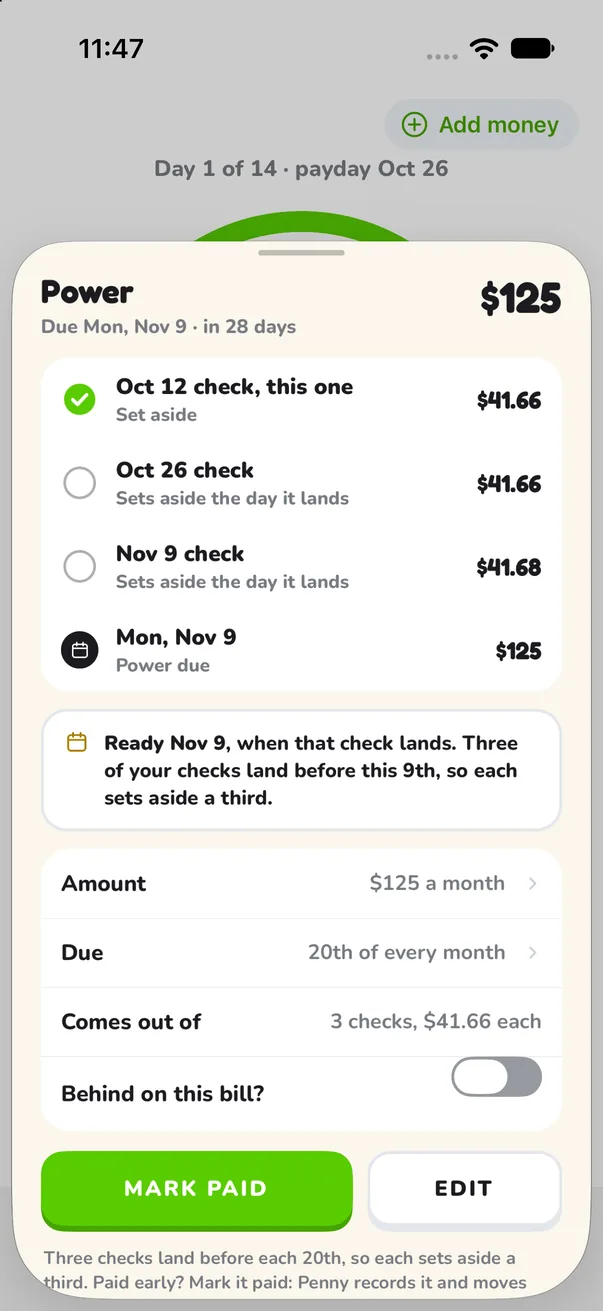
Penny does this per bill: when more than one check lands before a due date, each one sets aside its part.
4. Set a little aside
Before the spending part, take out whatever you're putting toward a goal: savings, a card, a car fund. Pick a number small enough that you'll keep doing it. Jordan picks $50 a check.
5. Plan the spending you know is coming
Groceries and gas aren't surprises. Give them a number for the two weeks. Jordan plans $180 for groceries and $80 for gas, $260 in all. Penny calls these envelopes.
6. Divide the rest by 14
| Take-home check | $1,480 |
| This check's share of bills | −$898 |
| Set aside | −$50 |
| Groceries and gas | −$260 |
| Left for day to day | $272 |
| ÷ 14 days = $19.43, rounded down | $19 a day |
| Left over at payday (14 × $19 = $266) | $6 |
$19 a day covers everything not on the list: lunch, a coffee, a random store run. If one day runs over, divide what's left by the days left and you have the new number. Penny does that part for you every time you log a spend.
Want to try it with your numbers? Use the paycheck budget calculator.
What about the months with three paychecks?
Biweekly pay comes 26 times a year, so two months (some years three) bring a third check. If you split monthly bills over two checks like Jordan, the third check in those months has no monthly bills on it. Decide its job before it lands. See your 3-paycheck months for 2026 and 2027.
When the daily number comes out too small
If the number can't cover food and gas, the plan isn't failing. It's showing you the gap on day one instead of the night before payday. The levers are the same for everyone: a bill that can move (some billers will change a due date if you ask), a smaller set-aside for this check, less planned spending, or extra money coming in. Which one is your call.

Penny does all six steps for you. Type your check and bills once; every payday she plans the new check and gives you one number a day.

This guide does arithmetic on example numbers. It is not financial advice.